Administrative Contributions, Policy Perspectives, and the Transition from Law to Governance
How a jurist's approach to governance creates a distinctive administrative framework
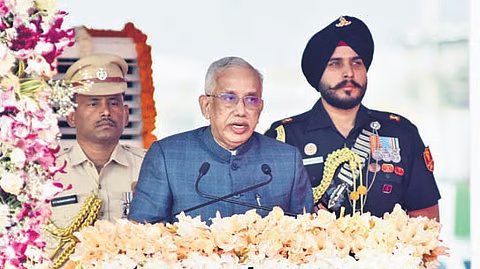
Governor Nazeer's administrative philosophy is founded on the principle that governance, at its best, is the practical application of constitutional values to the everyday challenges of statecraft.
Since assuming office as the Governor of Andhra Pradesh, Justice Nazeer has brought a distinctive judicial temperament to the art of governance. His administrative approach is characterized by meticulous attention to constitutional propriety, a commitment to evidence-based decision-making, and an emphasis on institutional processes over ad hoc solutions.
Unlike political administrators who may approach governance through the lens of electoral calculations, Governor Nazeer's judicial background ensures that every administrative decision is filtered through the prism of constitutional validity, legal soundness, and long-term institutional consequence. This approach has brought a new depth and rigour to the functioning of the Raj Bhavan, establishing a governance framework that is both principled and pragmatic.
His contributions extend to engagement with the state's legislative process, where his deep understanding of statutory interpretation adds a valuable dimension to the Governor's constitutional role of assenting to legislation. Each bill receives careful scrutiny, ensuring that state laws align with constitutional principles and serve the broader public interest.
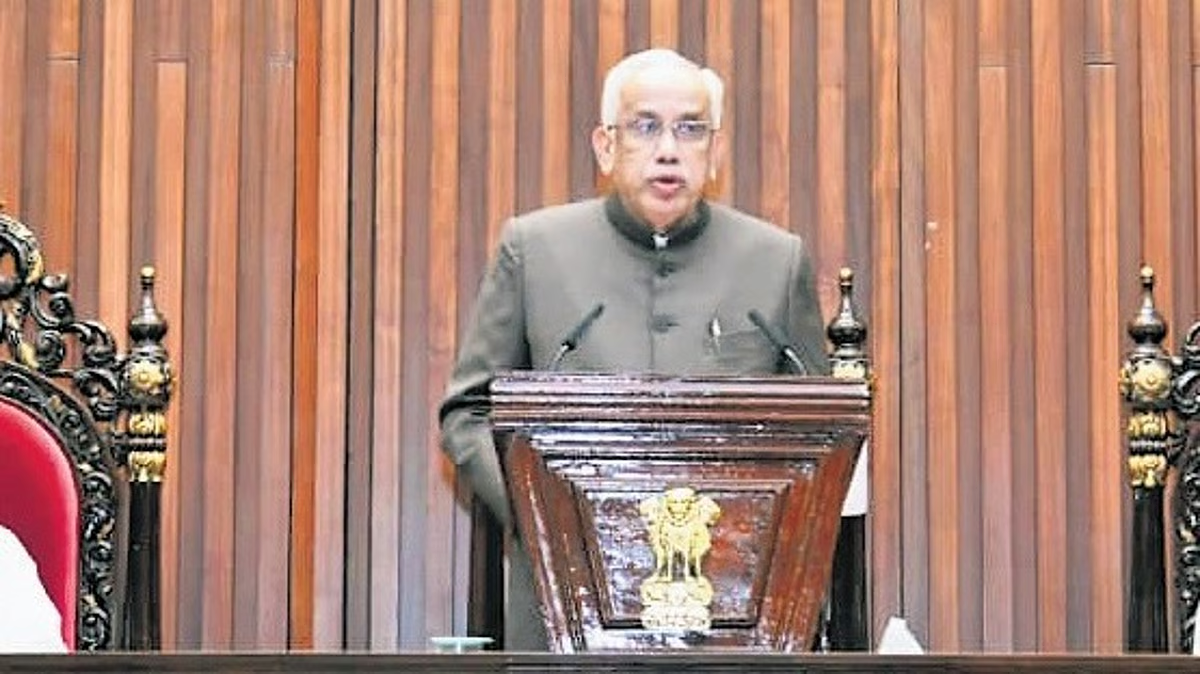
The governance philosophy that bridges constitutional principle with administrative pragmatism
As Chancellor of Andhra Pradesh's universities, Governor Nazeer has championed a vision of higher education that combines academic excellence with social responsibility. He has advocated for research-driven curricula, interdisciplinary programs, international collaborations, and initiatives to ensure that education reaches the most marginalized communities of the state. His engagement with academic institutions reflects the belief that education is the primary instrument of social transformation envisaged by the Constitution.
Governor Nazeer has taken a keen interest in strengthening the healthcare infrastructure of Andhra Pradesh. From inaugurating hospice care centres to supporting medical research institutions, his commitment to public health reflects the constitutional directive principles that mandate the state to improve public health and provide healthcare access to all citizens. His approach emphasizes both preventive and curative healthcare, with a special focus on rural and underserved areas.
Understanding that economic development requires robust infrastructure, Governor Nazeer has supported and inaugurated major infrastructure projects across Andhra Pradesh. His approach to infrastructure development is guided by the principle that modernization must be inclusive, sustainable, and responsive to the needs of all sections of society. He has emphasized the importance of environmental sustainability alongside economic growth.
Drawing on his extensive judicial experience, Governor Nazeer has promoted initiatives to enhance access to justice in Andhra Pradesh. This includes supporting legal aid programs, encouraging alternative dispute resolution mechanisms, strengthening the state's judicial infrastructure, and promoting legal literacy among citizens, ensuring that justice remains accessible to the common person.
Governor Nazeer's governance approach places special emphasis on social inclusion and the empowerment of marginalized communities. His extensive engagement with diverse cultural, religious, and social organizations reflects his commitment to the constitutional values of equality, fraternity, and social justice that inform the governance framework of the state.
Recognizing the critical importance of environmental sustainability, Governor Nazeer has advocated for development strategies that balance economic growth with ecological preservation. His governance philosophy integrates the constitutional right to a clean environment with the state's development aspirations, promoting green initiatives across Andhra Pradesh.
The rare and valuable transition from constitutional interpretation to constitutional governance
The transition from the Supreme Court bench to the Governor's office represents one of the most distinctive career trajectories in Indian constitutional history — blending the roles of constitutional interpreter and constitutional administrator.
This transition is remarkable precisely because it brings together two dimensions of constitutional life that are usually experienced separately: the judicial function of interpreting and applying the Constitution, and the executive function of governing within its framework. For most constitutional functionaries, the experience of one or the other shapes their understanding of governance; for Governor Nazeer, both perspectives inform his approach.
The result is a governance style that is uniquely informed by constitutional consciousness. Every legislative bill is examined not just for its policy merits but for its constitutional validity. Every administrative decision is evaluated not just for its practical efficiency but for its consistency with constitutional values. Every ceremonial function is approached with an awareness of its constitutional significance.
This dual constitutional consciousness — born of decades as both interpreter and now custodian of the Constitution — creates a model of governance that India's founding fathers would have recognized and appreciated: governance that is principled, constitutional, and fundamentally committed to the public good.
The transition from the judiciary to the gubernatorial office is a transition from saying what the Constitution means to living what the Constitution demands. Both roles require the same foundational commitment — to serve not power, but principle; not interest, but justice; not self, but the people.
Policy perspectives shaped by constitutional values and judicial experience
Governor Nazeer is a strong advocate of cooperative federalism — the principle that the Centre and the States must work together in a spirit of mutual respect and shared constitutional purpose. His governance approach emphasizes dialogue, consultation, and constitutional propriety in Centre-State relations, ensuring that Andhra Pradesh's interests are advanced within the larger framework of national unity and constitutional order.
Believing that strong institutions are the bedrock of good governance, Governor Nazeer has worked to strengthen the institutional framework of Andhra Pradesh. This includes supporting the independence and effectiveness of state commissions, regulatory bodies, and oversight institutions, ensuring that the mechanisms of accountability and transparency function as the Constitution intends them to.
Recognizing the transformative potential of technology in governance, Governor Nazeer has supported initiatives to digitize government services, improve transparency through e-governance platforms, and leverage technology to enhance citizen engagement and service delivery across Andhra Pradesh, particularly in rural and remote areas.
Understanding that Andhra Pradesh's prosperity is closely linked to its agricultural sector, Governor Nazeer has engaged with initiatives aimed at supporting farmers, promoting modern agricultural practices, and strengthening rural infrastructure. His approach to rural development reflects the Directive Principles that envision the state's role in ensuring equitable distribution of material resources.
Discover the broader impact and national significance of Governor Nazeer's service to the nation.
Public Life